
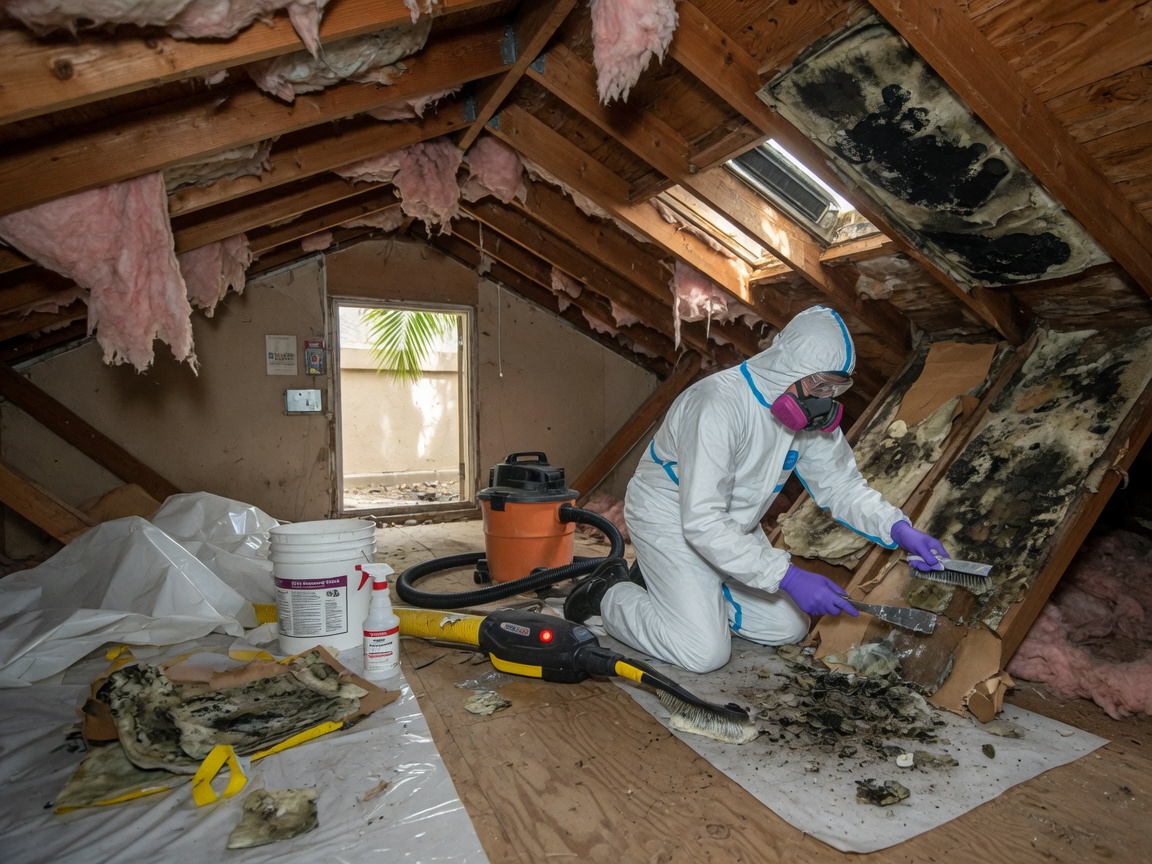
Palm Coast homes built before the 2000s in neighborhoods such as Palm Harbor and Indian Trails frequently show recurring attic mold because earlier treatments left roof deck moisture and ridge vent gaps untouched. The region's humid subtropical climate brings heavy summer rain and mild winters that keep relative humidity elevated, allowing spores to return within months when only surface cleaning occurred. Technicians at 148 City Pl inspect for condensation points along gable ends and check how tree cover from nearby Washington Oaks Gardens State Park limits airflow on certain lots.
Matanzas Woods properties often sit on slightly lower terrain that channels runoff toward foundations, pushing humidity upward through soffits. When a prior remediation skipped negative-air containment or failed to seal penetrations around plumbing vents, mold reappears along the north-facing rafters. Crews now map every bypass with moisture meters and thermal imaging before applying antimicrobial coatings rated for high-humidity environments, then restore insulation only after the roof deck reads below 12 percent moisture content.
Flagler County building practices from the 1990s left many attics with minimal ridge venting, a detail that becomes critical once summer temperatures climb and indoor air conditioning pulls moist air upward. Recurring cases also appear after storms near Flagler Beach when wind-driven rain enters through turbine vents that were never resealed. Each job includes a written report noting which sections of the attic require added baffles or powered ventilation to keep conditions stable year-round.
Technician insight
In Palm Coast the thing that catches most people out with recurring attic mold after previous cleanup is undersized ridge vents in 1990s homes across Indian Trails and Palm Harbor. The humid subtropical summers keep pushing moisture upward when those vents were never enlarged, so surface cleaning alone fails every time.
Matanzas Woods Recurrence
Homeowner in Matanzas Woods reported black spotting along rafters six months after an earlier treatment. Inspection found condensation at unsealed plumbing vents and blocked soffits from nearby tree cover. Crews added powered ventilation, sealed penetrations, and applied antimicrobial coating; follow-up readings stayed below threshold through the next summer.
Recurring Attic Mold After Previous Cleanup Services We Offer
✓Root Cause Moisture Mapping
Detailed inspection of roof decks, vents, and insulation in Palm Coast attics to locate hidden moisture paths missed during earlier cleanups.
✓Enhanced Ridge Vent Installation
Upgrade of existing ridge and soffit venting to improve airflow in homes throughout Indian Trails and Matanzas Woods where original vents are undersized.
✓Negative Air Containment Setup
Full containment and HEPA filtration protocol that prevents cross-contamination when re-treating attics that previously released spores into living spaces.
✓Antimicrobial Coating Application
Application of humidity-rated coatings on roof sheathing and rafters after source correction to inhibit regrowth in Flagler County's humid summers.
✓Insulation Replacement and Sealing
Removal of contaminated insulation followed by new material and air sealing around plumbing and electrical penetrations common in Palm Harbor homes.
Recurring Attic Mold After Previous Cleanup Cost in Palm Coast, FL
| Service | Typical Range | What Affects It |
|---|---|---|
| Recurring Mold Assessment | $175–$325 | Includes moisture mapping and written report; higher for two-story homes in Palm Harbor. |
| Source Correction And Cleaning | $650–$1,400 | Covers containment, treatment, and basic ventilation fixes; increases with insulation replacement. |
| Ridge Vent Upgrade | $450–$850 | Labor and materials for 20–40 linear feet; common in Indian Trails homes with original 1990s construction. |
Ranges are typical for Palm Coast, FL and confirmed with an exact written quote before any work starts.
How it works
- 1
Initial Assessment
Technician performs moisture meter and thermal scans of the entire attic, documenting bypasses and comparing readings against previous remediation photos.
- 2
Source Correction
Repairs or upgrades to ventilation, flashing, and insulation stops are completed before any cleaning begins to prevent immediate recurrence.
- 3
Containment And Removal
Negative air machines and HEPA filtration isolate the work area while affected materials are removed and surfaces treated.
- 4
Final Verification
Post-treatment moisture levels are rechecked and a written report is provided showing conditions that will keep mold from returning.
Pricing
Pricing varies with attic size, extent of prior damage, and required ventilation work.